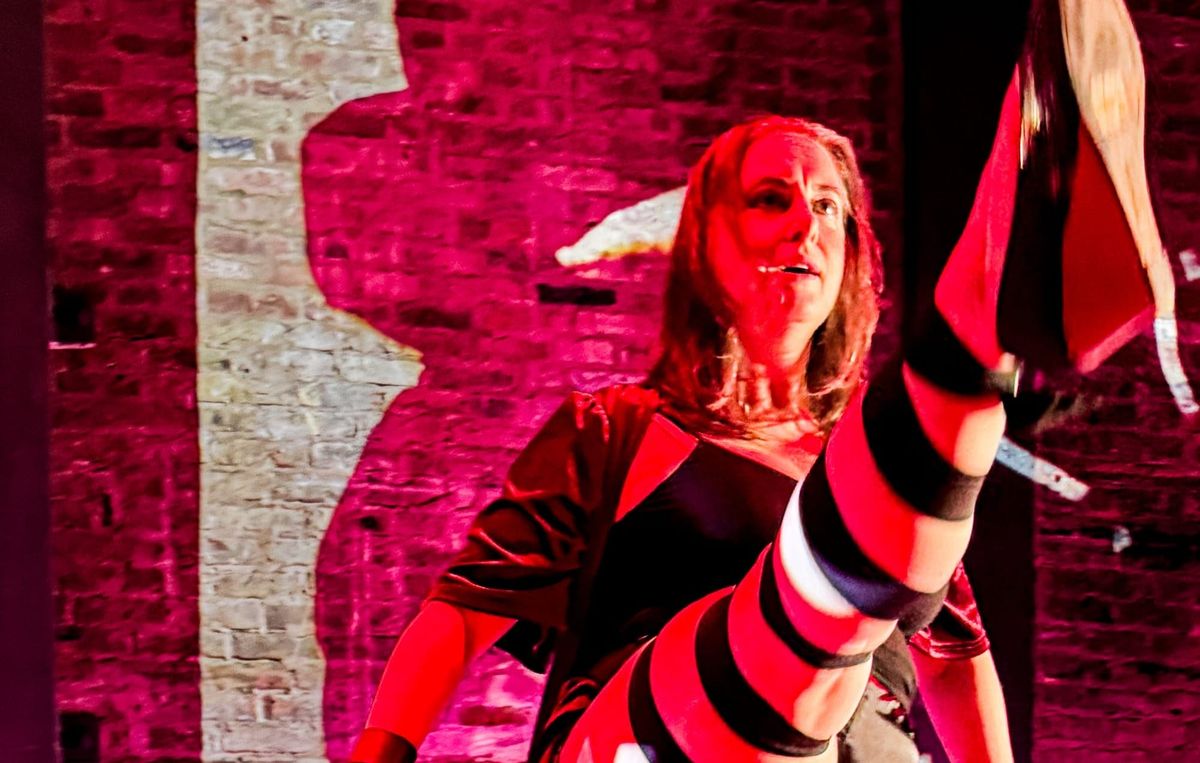
MAN WOMAN Directed, choreographed, and performed by Vangeline Costumes by Machine Dazzle Music by Ray Barragan Sweeten Lighting by Ayumu "Poe" Saegusa LaMama Moves! Festival at LaMama Experimental Theater, New York April 18, 2026
-- By Tom Phillips
Butoh artiste Vangeline continues to amaze and delight. Last year she was synching brain waves with a male Japanese dancer in a piece (which I didn’t see) called Man/Woman. This year she has dispensed with punctuation and partner, and become a complete being —male and female, animal, vegetable and mineral, down to earth and out of time. She calls it Man Woman.
This world premiere began with an image of woman weighed down with the colossal couture of a male-dominated world. All that’s visible of her is a pretty face encased in an enormous wad of robes, ruffles, and feathers – a trophy queen topped with a fanned-out black cockade, imprisoned by imperial edict. Left alone, she wrinkles her nose, puckers her chin – then discovers her hands amid the feathers, and tortuously works herself free, limb by limb.
It’s a Big Birthday, a Sestercentennial celebration. Jane Austen turned 250 December 16, 2025, with her reputation at an all-time high, her face now on Britain's ten-pound note, back-to-back with the King.
Born in 1775, the second daughter and seventh child of a country clergyman, farmer and teacher, Austen began writing around the age of ten and never stopped until her death at 41. She lived in a time of colonial turmoil and imperial warfare; her male characters include swashbuckling naval officers, a slave-owning patriarch, and members of parliament. But her scenes are set in the quiet English countryside, and her focus is inward, and female.
Austen revolutionized the art of fiction — turning it inside out with a deceptively informal technique that became known as free indirect discourse. From a perch within her characters’ sense and sensibilities, she chronicled and commented on their thoughts and feelings, creating a dialectic between narrator and character. She knew not only what they knew but also what they didn’t know about themselves, i.e. their unconscious drives and motives. And among these was sexual desire — a subject out of bounds for a female writer of Austen’s day, but as ubiquitous in a 19th-Century English village as anywhere in the world.
Little is known about Austen’s private life; her sister Cassandra burned most of her letters. However, one can hardly grow up with naval officers — her brothers — and share a bedroom with a sophisticated elder sister, without learning the ways of the world. And the world of Regency England was a school for scandal. While still a young woman, Austen spent five years in the urbane society of Bath, and displayed a keen knowledge of its dancing rooms and dating rituals in Northanger Abbey. She returned to the countryside a woman in full, and the novels of her mature period, beginning with Mansfield Park and Emma, reflect not just literary brilliance but depth of emotional experience.
-- By Tom Phillips Originally published in The Willa Cather Review, Vol. 66, number 2. Summer 2025
Willa
Cather’s
My Ántonia
is often read as a lyrical meditation on America’s frontier past.
However, Cather defended herself stoutly against charges of escapism,
or “supine Romanticism.” She believed in Art as
Revelation. Alongside her paean to the prairie is a sharp critique of
middle-American society and a vision of the conflicts that would roil
this country to this day, over issues of ancestry, color, gender,
language, and class.
The
story of the Shimerdas illustrates the paradox of
immigration–America’s xenophobic openness, a “nation of
immigrants” that fears and shuns foreigners. This is the context of
Ántonia’s father’s suicide, and her own hard-won independence.
In the end she builds a little Bohemia, a burgeoning family farm at a
distance from town. Speaking her native language with her children,
she is worn down but not defeated by her struggles with the
English-speaking establishment of Black Hawk, Nebraska. Meanwhile,
Jim Burden’s retreat to the East--to Harvard Law and moneyed
Manhattan–conveys the chasm between coastal elites and the
agricultural heartland. The
legacy of slavery also makes a central appearance in the plot. And
the whole is shadowed by an indigenous civilization all but erased by
America’s “manifest destiny.”
At
the same time, the long, loopy romance between Jim and
Ántonia--unconsummated but never abandoned–suggests the potential
for reconciliation. And Cather’s constant evocation of the
landscape places all her characters on common ground. As Lena Lingard
says, “it ain’t my prairie.” The beauty and mystery of the land
belongs to all; sun and wind diffuse the strains of a pluralist
culture where change is rapid and trust often fleeting.
No one who has seen a championship boxing match, and watched the fighters fall into each others' arms at the final bell, can doubt the emotional power and depth of boxing. No sport offers a better metaphor for life, in all its glory and humiliation.
Shadowboxing is something else. It's punching the air, the only target being an image of yourself. In boxing, it's an essential training exercise. As a metaphor for life, it runs the risk of self-obsession. That seems to be case with "Shadowboxing in Blue," an all-female production of music, dance, theater, boxing, and psychology, that will disappoint fans of all five disciplines.
I wrote this in 2021, re-read it today, and didn't change a single word.
Press enter or click to view image in full size
Photo by Jesse Mills
Out for a late-night walk this week, I saw what’s become a familiar sight in September — a beacon shining up from the former site of the World Trade Center. This lonely blue beam seemed a symbol of the narrow view Americans have taken on the events of twenty years ago.
I knew people who were killed in the World Trade Center that day, and others who barely escaped. The thousands of civilians who died were victims of an atrocious war crime. Even so, I agree with those who say it’s time to re-examine what happened and why.
The 9/11 assault on America was not an isolated act of “terrorism.” It was a shot heard round the world, as momentous as Lexington and Concord — -the opening battle in a clash of civilizations. It’s a war that was long in coming, still going on, and which we are inexorably losing.
The George W. Bush administration was warned of the 9/11 attacks by US intelligence which it chose to ignore. But the public had been warned much earlier— in a 1993 essay by a Harvard historian. In the journal Foreign Affairs, Samuel Huntington wrote that the next world war would be a “clash of civilizations” — a counter-raid by conservative Muslim and Confucian societies against America’s world empire.
Huntington’s essay was hastily dismissed by other historians. In a follow-up issue of Foreign Affairs, middle-east maven Fouad Ajami insisted that world wars could only be fought by state powers. Ajami later became a supporter of the US invasion of Iraq, which was in line with his theory but detached from reality. The reality is that the United States is the leader not of a free world, but a failed world, and its enemies are those who don’t want to live in it.
Our nation was founded on a unique phrase — the “pursuit of happiness.” Thomas Jefferson’s declaration was based on English philosopher John Locke, who argued for the rights of “life, liberty and property.” Jefferson preferred a final phrase so vague that it could inspire both a runaway slave and the bounty-hunter chasing him through the woods.
Thus we have pursued happiness for nearly 250 years, and wound up more miserable than we began. As F. Scott Fitzgerald described it in The Great Gatsby — “There are only the pursued, the pursuing, the busy and the tired.”
Happiness has taken the form of outsize property holdings, low taxes, racial privilege, gouging the environment, exploitation of labor, disregard for the poor, and a glut of consumer products, from salty snacks to SUVs, designed to addict their users — -all wrapped in an avalanche of plastic waste. We’ve had our ups and downs, but starting on 9/11, the world delivered its verdict on the American empire.
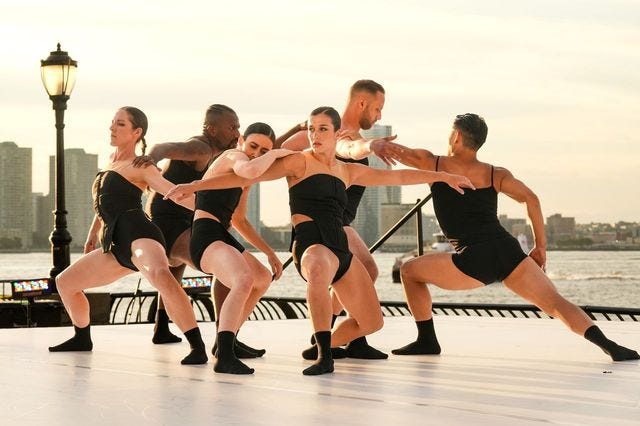
Battery Dance in Frontiers: Photo by Steven Pisano
“Why do they all look so mean and weird?” whispered my companion as we watched six black-clad dancers writhe and scuttle, spin and splay on a stage by the Hudson River. “Maybe they’re zombies?” I guessed.
No, it’s worse, I later thought. These are not the undead, because they were never alive. These are our new companions, beings who are not and have never been. In a twist, "Frontiers" shows us human beings dancing like AI creations.
Everyone knows that post-modern dance began at Judson Memorial Church in the early 1960s, but few people today remember what actually happened there. Luckily, the Village Voice was on the story,
and sent its most daring critic to cover it. Jill Johnston’s columns of the 1960s and 70s have now been collected in a book, an invaluable chronicle of dance in the context of a social/sexual/political sea change.