Saturday, June 7, 2014

Serenade at Eighty

-- By Tom Phillips

Eighty years ago this week, a new art form was brought forth on this continent.   On June 10, 1934, George Balanchine and Lincoln Kirstein’s fledgling School of American Ballet performed the first ballet choreographed on and for American dancers – Balanchine’s Serenade.  It was the beginning of a revolution, but not the kind that anyone expected.  
  
When Balanchine arrived in America in 1933, a refugee from imperial Russia, no one was clamoring for a new classical ballet with music by Tchaikovsky.  These were the depths of the Great Depression, the heyday of John Steinbeck in America, and Socialist Realism in Russia.  The arts were expected to reflect the social and political struggles of humanity.  Modern dance seemed much closer to the spirit of the time.  And the main figure in modern dance was Martha Graham, whose whole career had been a revolt against the ballet tradition.

Serenade starts with a tableau that could have been created by Graham.  Seventeen girls stand in blue light, their feet straight ahead.  One arm is raised, the hand flexed toward the vertical. Balanchine reportedly told them they were “blocking the moonlight.” The position is un-balletic, the expression anti-romantic; but suddenly it begins to transform.  The wrist curves and circles overhead, then diagonally across the center line of the body, followed by the gaze; the arms form a ballet position at the hips. Then, without warning or preparation, seventeen pairs of feet suddenly turn out from parallel to first position. The floor squeaks in protest. The movement is abrupt, almost violent -- not an impulse from within, but a discipline imposed from outside. Graham herself said the first time she saw it, tears sprang to her eyes. “It was simplicity itself,” she said, “but the simplicity of a very great master.”

Next the heads lift, the arms rise and spread out, and the torso lifts as the right foot points to the side.  The dancers breathe and expand, no longer blocking the moonlight, but open to the world in front of them.  The sequence could end here, but it doesn’t. Balanchine – who talked of “forcing” beauty out of human material — closes the feet, crossing the ankles to the fifth position. The arms again rise and spread, but this time the bodies reach beyond the vertical, looking to the sky. “Blocking the moonlight” has been transformed, step by step, into ballet, into an opening toward the heavens.  Balanchine’s young ballerinas have yet to move from their places, or even bend their knees, but they have already foreshadowed the drama to come: the transcendence of modernism by classicism.

Friday, May 30, 2014

Chairman Mao and the Goddess

-- by Tom Phillips

Twenty-five years ago this May, I went with CBS News to cover what turned out to be historic events in Beijing.  We were the only crew from a major U.S. network on the scene, but it wasn’t because we knew what was going to happen.  We were planning to cover the meeting of Soviet leader Mikhail Gorbachev and China’s communist party leaders – a summit conference that became just a footnote to the tumult in Tiananmen Square, and throughout China. 

The pro-democracy protests that swept China in 1989 had been building up for weeks, and climaxed in mid-May with a huge demonstration that filled Tiananmen Square with more than a million people.  Protests were also reported in hundreds of other Chinese cities.  It came about because of a confluence of factors – mourning for the death of a leading party reformer in April, spring weather and spring fever, the presence of foreign reporters and loosening of press restrictions for the Gorbachev visit.   But it also had to do with the global atmosphere – Gorbachev’s reforms, the implosion of the Soviet empire in Europe, the rise of democratic aspirations everywhere.  It felt like an unstoppable movement – democracy was coming to the People’s Republic, for a billion people in the world’s largest civilization.    

America, or the idea of America, was the ultimate inspiration.  The students tried to build a papier-mache replica of the Statue of Liberty, but the torch sagged when held with just one arm, so they rebuilt it with the other hand holding the wrist for support.  They called it the “Goddess of Democracy,” and installed it in the square, facing the huge portrait of Mao Zedong.  This reportedly enraged the communist party hard-liners. 

Demanding democracy, the student leaders set up their own little democracy in the square.  Everything had to be voted on.  We discovered this when producer Susan Zirinsky and I, rushing back to the hotel, took a shortcut across the square.  When we arrived at the edge a security fence was in the way, right next to one of the student command posts.  Zirinsky, never one to be denied, was not about to turn back.  She pleaded with the students, dropping the names of their leaders, saying all we were trying to do was get their story out.  They huddled and voted, all their hands shooting up simultaneously.  We won, and jumped the fence. 

Saturday, February 1, 2014

The Age of Melody

After watching the Grammy Awards on TV this week, I came away recalling some inviting rhythms (Daft Punk), biting lyrics (Lorde), and sweet voices (Kacey Musgraves) -- in addition of course to the costumes and special effects.  But I can’t say I came away with a catchy new tune.  The age of melody is long gone. Tunes took a back seat starting in the 1950s, displaced first by rockin’ rhythms, then by the lyrics of folkie songwriters.  In the age of the singer-songwriter, a tune was just a few repetitive notes to hang the verses on.  And in rap music, melody disappeared completely, as music got down to just the word and the beat. 

Someday, melody is going to make a big comeback.  That’s not because any of the above trends were wrong or not necessary.  It’s because melody is the element of music that says the most, on the most basic level.  It’s the musical statement that stands for the whole piece.  And it lasts longest in the memory.

Wednesday, January 1, 2014

Outside Llewyn Davis

                                             “There was music in the cafes at night,
                                                And revolution in the air.”
                                                                   B. Dylan   
                                                     
Critics are raving about “Inside Llewyn Davis,” the new film by Joel and Ethan Coen evoking the Greenwich Village folk scene of 1961.   But the Coen brothers, and most of the critics, weren’t there at the time.  As one who was there, I’d say the Coens got it wrong.

Not so much in the details. McDougal Street looks a lot like it did in 1961, with the coffee houses and the grimy Kettle of Fish tavern.  The Gaslight Café, which in the film is a mash-up of the Gaslight and Gerde’s Folk City, looks like neither, but enough like a typical folk club of the period.  Oscar Isaac, as the title character, looks and sounds a little like Dave Van Ronk, on whom he is “loosely based,” though both his beard and his voice are neater, his guitar playing is nowhere as complex and sophisticated, and his commitment to folk music is suspect.  The surrounding cast of characters – the sleazy bar owner, the dysfunctional folk-record producer, the mumbling beat poet, the chick who sleeps with too many guys, the kindly abortion doctor, the phony folkies who hope to cash in on their music, the cynical talent manager who knows how to make that happen --  are all based on real types of the period. 

What’s missing is the spirit – the electric atmosphere that made the Village a magnet for every kind of artistic rebel.   Llewyn is a loser, a self-absorbed artist, easily discouraged by failure.  Dave Van Ronk was a musical genius and an indomitable force on the folk music scene.  He never made money from it, but he never quit, and he never quit because he loved the material so completely that he made it his own, his own identity.  To watch and hear him perform for small change in the Gaslight Café was like a religious experience – he hovered over his guitar, savoring notes as he bent them into blues, croaking out the old complaints in his untrained, roughed-up but gentle high tenor voice.   Here was a man in love with an America that had practically disappeared in the militarized, commercialized and sanitized world of the forties and fifties.  In love, and able to express it in songs he’d copied and adapted from obscure field recordings.   And not about to sell it out, or give it up, no matter what. 

Tuesday, December 10, 2013

Double Feature: A Century of War

In a special year-end publication, the French newspaper Le Monde calls the hundred years just ending, 1914-2014, “Un Siecle de Guerre,” a century of war.  The editors divide it into four periods of conflict – World War One, World War Two, the Cold War and Decolonization, 1945-1991, and Separatism and Terrorism, 1991-2014.  These hundred years have been, and will be, the subject of myriad histories.

But a great work of art is worth a hundred history books.  In my opinion, if you want to understand the last century, skip the political and military potboilers, and see just two great movies:  Jean Renoir’s “The Grand Illusion,” from 1935, and Gillo Pontecorvo’s “The Battle of Algiers,” from 1966.  "Grand Illusion” ushers in the collapse of European civilization from 1914 to 1945.   “The Battle of Algiers” is all you need to know about the clash of civilizations that has roiled the world ever since. 

Sunday, September 15, 2013

The Road to Dotage 3: My Back Pages

                                  
                                   “I got no future, baby, I know my years are few.
                                    The present’s not that pleasant; just a lot of things to do..” 
                                                                                    L. Cohen  

Every summer you learn something about yourself.  It’s the time of year when structure breaks down, when you drift off to different places, some boring, some exciting; you do new things, you do the same old things, but sometimes they come out different.   This summer I learned that I can no longer dance every day and night.  

I’ve been going to dance camp with the Country Dance and Song Society nearly every summer since 1976.  The first year it was American Week at Pinewoods Camp in Massachusetts.  We did Appalachian clogging, contras and squares, plus I took a fiddle workshop and sang early American hymns.  This took place in the woods and went on all day and half the night.  It was the total opposite of my life in the city, working in a tense newsroom, visiting my children on weekends in a broken home.   

I got so high at Pinewoods – on nothing but dance, music, women partners, a black pond and country air – that I could hardly sleep.  I would stand outside my cabin in the dead of night and vibrate in the wind, shaking with a continual attack of energy, howling silently through the trees. 

Tuesday, July 9, 2013

Mandela's Moment

-- By Tom Phillips

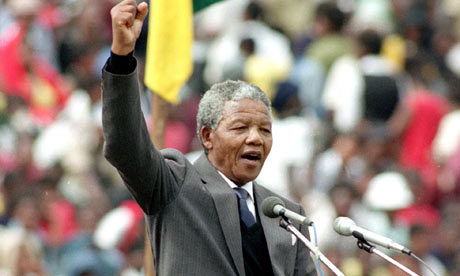
In 1990, when the South African government released Nelson Mandela from prison, the whole country was eager to see the man who had led the African National Congress and the anti-apartheid movement from behind bars for nearly 28 years.  But no one knew what he looked like.  Black South Africans wore T-shirts with a picture of Mandela when he was a young boxing champion, with a full face and cannonball shoulders.  

When he finally appeared a few days later at a packed soccer stadium in Soweto, he was a slim, white-haired man in a suit and tie, moving calmly through the crowds, with the bearing and manner of a king.  I was there with CBS News, and this is what I saw.