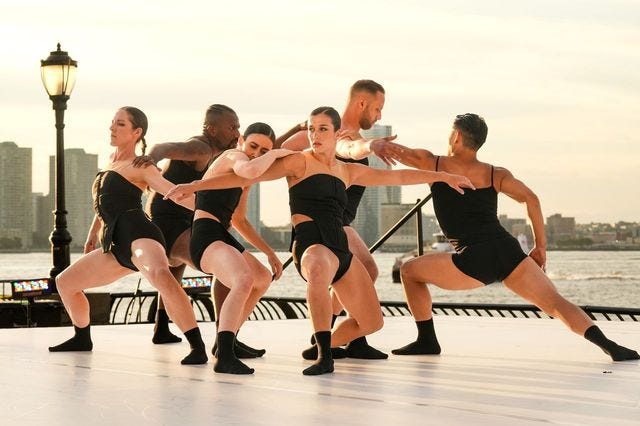
Showing posts with label dance. Show all posts

Friday, May 15, 2026

Mama Anabella

Mama Anabella

Distance / decay / by Pioneers Go East Collective
Anabella Lenzu, choreographer/performance artist
Gian Marco Riccardo Lo Forte, director & filmmaker
LaMama Experimental Theatre Club
New York, New York
May 8, 2026
---
By Tom Phillips 


In the unlikely event that women ever achieve equal rights in America, someone should put up a statue of Anabella Lenzu. In her new solo, she dances the full scope of humanity in female form.  

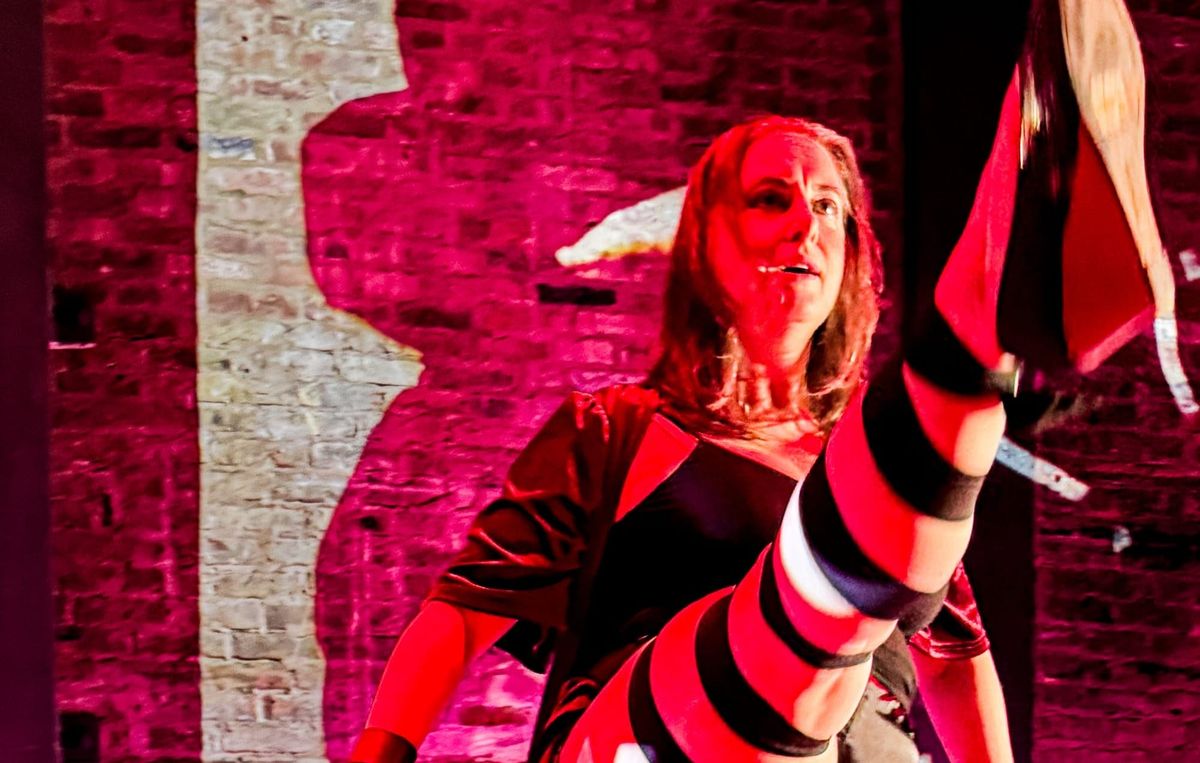
Distance /decay / begins in captivity. To a sound track of solitary, sad poetry by the late Argentine feminist Alejandra Pizarnik, Lenzu adds the scratch of a live microphone on her tight sequined party dress. She circles her breasts and digs into her belly, searching for the life within. She strips off the glitz, down to a leotard and bare legs, but then has to tear up a series of pictures and diagrams that cover her torso and face. Gaining strength with each false image that falls to the floor, Lenzu picks up a huge megaphone, shouts into it, but abruptly gives up and covers her head with it.

What follows is a demonstration of the power of dance drama. Lenzu dons a deep red cape and performs a slow, fierce tango. Then she straps her legs like a Roman gladiator and marches with soaring battements across the stage, slashing the air with her cape like a bullfighter. Rocked back in our seats, struck dumb, we watch as she exits and a minute later returns with a sweet smile and a modest bow—once again a mother, teacher, artist and friend..

A double immigrant from Argentina and Italy, Lenzu radiates the warrior ethos of ancient Rome and the steely dignity of flamenco and the bull ring, without losing a drop of her maternal warmth and intelligence. Grazie, Anabella. We get it.

Tuesday, October 7, 2025

Air Boxing in Brooklyn

 -- By Tom Phillips 

Photo: Lisabel Leon 

No one who has seen a championship boxing match, and watched the fighters fall into each others' arms at the final bell, can doubt the emotional power and depth of boxing.  No sport offers a better metaphor for life, in all its glory and humiliation.  

Shadowboxing is something else.  It's punching the air, the only target being an image of yourself.  In boxing, it's an essential training exercise.  As a metaphor for life, it runs the risk of self-obsession.  That seems to be case with "Shadowboxing in Blue," an all-female production of music, dance, theater, boxing, and psychology, that will disappoint fans of all five disciplines. 

Monday, August 11, 2025

Dancing the Future: AI at the Battery

 --By Tom Phillips 

Battery Dance in Frontiers: Photo by Steven Pisano

“Why do they all look so mean and weird?” whispered my companion as we watched six black-clad dancers writhe and scuttle, spin and splay on a stage by the Hudson River. “Maybe they’re zombies?” I guessed.

No, it’s worse, I later thought. These are not the undead, because they were never alive. These are our new companions, beings who are not and have never been.  In a twist, "Frontiers" shows us human beings dancing like AI creations.  

Wednesday, May 21, 2025

The Theatre of Life: Jill Johnston


Jill Johnston, c. 1970    
The Essential Jill Johnston Reader
Edited by Clare Croft
Duke University Press, 2024

Everyone knows that post-modern dance began at Judson Memorial Church in the early 1960s, but few people today remember what actually happened there. Luckily, the Village Voice was on the story, 
and sent its most daring critic to cover it. Jill Johnston’s columns of the 1960s and 70s have now been collected in a book, an invaluable chronicle of dance in the context of a social/sexual/political sea change.   

Wednesday, February 19, 2025

The Dance a Coup Couldn't Cancel

US Patriots at the Pyramids 

The White House’s first wave of assaults on government-funded programs left many defunct or disabled. But at least one group managed to carry out its plans, without federal funds and in defiance of an order to stop. These intrepid and inspired artists are the performers of Time Lapse Dance, led by New York choreographer Jody Sperling (center, above).


With a grant from the US Embassy in Cairo, the company spent three years planning a tour--- to perform for children and young people at Egypt’s Hakawy International Arts Festival. On Sunday, January 26th, the day before they were to depart, Sperling woke up to a message from the State Department: her grant was terminated and she must stop the program immediately.  It was a short phone call, she says. She was in shock.  The costumes were all packed, the plane tickets purchased.  She began a frantic round of fund-raising, and re-negotiating contracts with her Egyptian hosts.  “They can’t stop us from going,” she said.  Long story short: the cancelled tour went on. 

Monday, January 20, 2025

Obsessed with Light


Loie Fuller 


"God said, 'Let there be light.'  And there was light."  Genesis 1:3

"Edison's here to stay."  The Bee Gees 

"We don't know what light is.  We can't even see it until it strikes something."   Jennifer Tipton 

The last of these quotes comes from the New York's leading theatrical lighting director.  And it represents the mystery at the heart of a dazzling new documentary, "Obsessed with Light." The film is about an obscure character in the history of dance -- Loie Fuller, a "western gal" from Kansas who became a sensation in Paris a hundred years ago.  But ultimately it is about the miracle of human creation -- what we do with the light God gave us, and the light we make for ourselves. 

Fuller created exotic dances that she and her company performed in outsize costumes, with a home-made apparatus that extended their arms into wings.  And she lit them with early electric light, through a hand-painted color wheel.  The poet William Butler Yeats was mesmerized:        

When Loie Fuller's Chinese dancers enwound 
A shining web. a floating ribbon of cloth,
It seemed that a dragon of air 
Had fallen among dancers, had whirled them round 
Or hurried them off on its own furious path... 
                              --- Nineteen Hundred and Nineteen   

Yeats's poem was about a world gone wrong -- emerging from the disaster of World War One only to whirl heedlessly into even greater catastrophes. And today, as we hurtle into the second coming of  President Trump, Loie lives.  

Her mantle, her floating ribbon of cloth, has been picked up by New York choreographer Jody Sperling and her Time Lapse Dance company.  They bring Loie to life in the film, performing new works and lighting them with contemporary technology that Fuller could only dream of.  The finale is a dazzling solo by Sperling in which the dancer disappears and all we see is light playing on her whirling robe. 

Turning and turning in the widening gyre, wrote Yeats in his "Second Coming."  Turning is what Sperling and her dancers do, turning themselves into instruments of fabric and light, a light that is not overcome by the darkness.  Time Lapse Dance has taken up the cause of the Earth.  They dance as trees, or wind, or covered with plastic bags, as garbage.  Sperling calls them "eco-artists," in residence at the New York Society for Ethical Culture, a nearly 150-year-old organization that stubbornly clings to its dreams of creating a better world.  Following in Loie Fuller's footsteps, Sperling and her troupe will be touring and teaching in Egypt next month at the invitation of the US Embassy in Cairo.   

Fuller's apparatus, made of wood, serves to bridge the gap between humanity and nature--- doubling the reach of human beings, endowing them with godlike presence.  In the shadow of the pyramids, Time Lapse Dance will be dancing for civilization to survive its obsessions, for humanity to save its home.    

Meanwhile "Obsessed with Light" -- a labor of love by directors Sabine Krayenbuhl amd Zeva Oelbaum -- has been picked up for distribution in the US and Canada, and held over at the New Plaza Cinema in New York.  It is exhaustively researched, elegantly shot in its interviews with Tipton and other artists inspired by Fuller, and most of all brilliantly edited, mixing new material with snippets of Fuller in black and white and color.  Loie would be thrilled, and so will anyone who cares about dance, film, life, light, and this world.   

-- Copyright 2025 by Tom Phillips


Monday, January 13, 2025

Hip-Hop Conquers K-Pop

"Trivial Perfection" Photo by Richard Termine

Japan Society’s 2025 Contemporary Dance Festival offered a gender sandwich Saturday night, reflecting some of the current cultural turmoil in east Asia. An all-male troupe from Korea opened the program, and an all-female ensemble from Japan ended it. In between was a pas de deux from Taiwan, with a twist or two.

The K-boys — five guys who call themselves C.Sense, short for crude sensibility —won the audience and the night hands down, or rather hands up, with a precision workout they called “Trivial Perfection.” In T-shirts and gym shorts, they turned simple movements into complex forms and moving shapes — pyramids, spirals, implosions and explosions. They started with finger-flexing, proceeded to arm-flapping and hand-slapping and then body-slamming — chest to chest like football players. The wild card was the fifth guy, an androgynous musician who sat quietly at a keyboard for most of the piece, creating a background stew of hums and pings. Toward the end he picked up an electric guitar and broke into a corrosive, heavy metal blues break a la Jimi Hendrix. The four dancers responded, each with his own break-dance variation. It was like self-expressive American culture breaking into the traditional collectivism of east Asia. Hip-hop has conquered the world, and K-pop has embraced it.

“Nobody takes ballet any more,” sighed my companion, a former dancer, during the break after the first piece. “All they do is jump around and roll on the floor.” And sure enough, the pas de deux from Taiwan titled “…and, or…” featured acrobatic tumbles and off-balance leaps and lifts. The plot was familiar: boy chases girl and girl chases boy through every conceivable approach and avoidance. They share a nice little hug toward the end, but the conclusion is almost as ambivalent as the beginning. The innovation was in the casting —choreographer I-Ling Liu deliberately chose a small man and a taller woman — going not for gender reversal, she said, but gender equality. And in fact they seemed to be of equal strength, and were able to lift and throw each other around in turn. The dance was fast-moving, the moves were difficult and pulled off with elan, and it was performed successfully without any music. Liu said she wanted to challenge the audience to just watch the dance. We were up to it.

Japanese choreographer Ruri Mito and her eight-woman troupe closed the program on an ambitious but ambiguous note. In “Where we were Born,” Mito said she was trying to re-create the origins of life. In murky light, the women formed a moving blob that surged and swayed, peaked and fell, briefly broke up and quickly reformed. According to Mito the piece was made to be seen in the round, and it suffered on the square proscenium stage at Japan Society.  It looked like the psycho-pathology of Japanese womanhood--- non-individuals lumped together, living a primitive existence in the dark.   

I longed for the lights to come up and individual dancers to step out, but it wasn’t going to happen. So we saw one side of a blob that remains a mystery. Once again the ensemble dancing was impressive, a bit like an English sword dance where dancers are linked together, never let go and must move as a unit. But here you had little idea of what was going on inside the blob.   

"Where we were born"  Photo by Richard Termine 
         

As always, the program curated by Japan Society’s artistic director Yoko Shioya was on point — top quality dancing that reflected the current cultural turmoil of east Asia. Some Korean women are refusing to have anything to do with men, and Japan’s birth rate is cratering. Things may be more normal in Taiwan, at least until the Chinese invade. But whatever happens, hip-hop’s not going away.


Copyright 2025 by Tom Phillips 

Tuesday, December 10, 2024

Truth and Tinsel


 - By Tom Phillips

If you want to test the authenticity of a performing artist, a good place to look is the cutting room floor — in the outtakes. There you see how an artist works, and what they're aiming for.  Outtakes are the raw material for a deep and funny dive into he world of performance, about to disappear from view at the tiny Tank theater in midtown Manhattan.   

Friday, January 20, 2023

Listen to your Mother


--  By Tom Phillips 

It's a work in progress, and it has a long way to go, so this is not a review.  Just the facts. 

On the evening of January 18, 2023, dancer-choreographer-teacher-mother Annabella Lenzu took two saturated sponges, placed them on her breasts and squeezed until water ran down her slip and onto the floor at the LGBTQ Center in Greenwich Village. 

This demonstration of what it feels like to be full of milk was just one of the indelible images left by her half-hour showing of "Listen to Your Mother," a feminist rant about the problems of being an artist and a mother -- an impossible combination of callings.  It's almost too much to bear -- but Lenzu bears it, so we have no way out.  

Friday, September 30, 2022

Isadora Today: Interview with Lori Belilove


Co_BrahmsTanagra_Z063471
The Isadora Duncan Dance Company at Untermyer Gardens, 2022
Carolyn Yamada, Samantha Mercado, Hayley Rose, Diana Uribe, Emily D'Angelo   

--  By Tom Phillips 

Isadora Duncan was and is an outlier -- 100 years ago, a rebel against the academic dance establishment, and now, a pure classicist in a free-wheeling, eclectic dance environment.  Today, no one embodies Isadora’s life and work more than Lori Belilove, director of the Isadora Duncan Dance Company and Foundation.  Working out of a loft-studio in Manhattan’s Chelsea neighborhood, she has spent decades as a dancer, teacher, and choreographer, re-inventing Duncan Dance for the 21st Century.  I talked with her over the last year, most recently on the last day of summer, 2022. 

Monday, November 1, 2021

Womanspreading: Butoh Redefined

Vangeline 
"Eternity 123" 
Triskelion Arts, Brooklyn 
October 30, 2021

 --  By Tom Phillips 

Butoh queen Vangeline describes her solo "Eternity 123" as a "symbolic journey of women's liberation across time."  I tossed the program note aside and watched the show with an open mind, with which the artist proceeded to play.   

The piece begins with nothing but a dress -- a full-length, frilly see-through chiffon -- draped over a slip, revolving in the air.  In time the dancer appears behind it as a pair of feet and two sets of fiddling fingers, and proceeds to inhabit the garment.  

This is woman as clothes hanger -- seen but not heard, seen but not seen. Blackout.  

The next scene has the dancer wearing the dress, to the second movement of Beethoven's Seventh Symphony. Facing rear, she does nothing but turn her head into profile, then back, moving imperceptibly over a span of eight minutes. The music, built on a single rhythmic motif, moves majestically through a minor march and a major fantasia, ending like a wave breaking over the rocks of some desolate shore. Vangeline's sound score adds birdsongs in the background.  By the middle of the movement I scribbled excitedly in my notebook Art, Nature, and Humanity--- and felt a half-forgotten sensation creeping up from my entrails.  Mesmerized by the beauty of that half-turned face, I was falling in love!  

This is woman as ideal, semi-paralyzed on a pedestal. Blackout, reset. 

To crowd noise and the strains of the Blue Danube Waltz, the next scene has the dancer again facing rear, but with the arms in motion, rising in a super slo-mo port de bras, then twining the fingers behind the neck, then down behind the back -- until voila! off slips the frilly vest, leaving the torso and arms in just a translucent slip.  Here's a hint of burlesque, a strip-tease --- woman as object, but a fleshly object, as real as any man.  Blackout.  

By this time I was feeling like Virginia Woolf's Orlando, morphing through centuries of changing gender roles -- ready for anything in the 21st.  

Bare-legged now and sprawled on the floor, a blob of wounded flesh, Vangeline appears helpless. Will she die?  The answer comes in a metamorphosis. She begins to move in jerks and spasms, face contorted as she works her jaws as if for the first time. Slowly and steadily, her strength and control increase as she extends her limbs, pushes herself up, then balances on her hips in a flying V-shape--- hands and feet in the air, body held in place by nothing but bands of abdominal steel. Finally, she takes a quarter-turn to face the audience, and eases her body into a symmetrical shape -- knees spread, toes touching on the floor, a perfect quadrangle below the waist, spine lifted above -- balanced in meditation, eyes open, living and breathing, meeting the gaze of the audience, equal and opposite. . 

You know "Manspreading?" This is Womanspreading.  And it's here to stay.  

Next up for "Eternity 123," a US tour.  It's E-Vangelism at its best. 

-- Copyright 2021 by Tom Phillips 
Photos by Bryan Kwon 


Saturday, April 24, 2021

Rites of Spring

-- By Tom Phillips  

Jody Sperling/Time Lapse Dance 
One problem in dealing with the world’s environmental crisis is that it’s composed of so many interrelated problems, most of them difficult to picture. Science does a lousy job of dramatizing climate change – so by the time people are forced to recognize it, their homes may be gone and their lives in danger.  And so it falls to the arts to show what business-as-usual is doing to us.  And Earth Day is an annual opportunity to seize the outdoor stage. 

Thursday, January 28, 2021

Groovin'

 LaMama Moves/Online

Tamar Rogoff with Merri Milwe
"Wonder About Merri"
Kevin Augustine/Lone Wolf Tribe 
"Body Concert"
Tamar Rogoff with Mei Yamanaka
"The Yamanakas at Home"

-- By Tom Phillips

2Yamanakas
The Yamanakas at Home 

 It's not that often that three disparate dance pieces fit together so well that they seem to be subtly referring and commenting on each other -- but last night's trio of experiments from LaMama seemed to have been made with each other in mind.  The bookends were two short pieces by Tamar Rogoff --  one set in downtown Manhattan, the other in a residential neighborhood of Tokyo -- with entirely different characters and themes, but a single groove -- a Motown beat that gets you on your feet, and won't let you do anything but dance.